
Many sports have playoff selection systems that are sub-optimal in one way or another.
But the Cricket World Cup’s Net Run Rate tie-breaker seems to stand out as pretty bad.
Let’s take a deeper look at why there could be a problem, and what could be done to improve it.
- Background on tournament rules: each team plays 6 pool games, and receives 2 points for a win, and 1 point for a draw or no result. There are two pools of 7 teams, and after the pool play the top 4 teams in each pool are pushed through into a sudden death format. Firstly, if teams are on equal points at the end of pool play, the team with the most wins will progress (more details in the official rules).
Nothing surprising here so far.
The kicker though, is in the Net Run Rate (NRR) mechanism used to rank teams that finish the pool stage on equal points and equal wins.
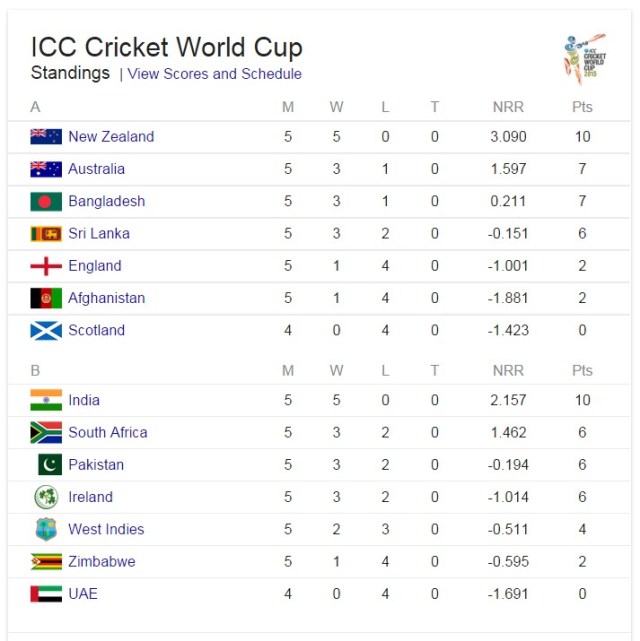
Please note below that there are 7 teams that are currently ranked subject to NRR, and that only four teams in each pool can make the finals. It’s therefore important that NRR is as accurate as possible.
So what’s the problem?
The NRR equation does not take into account wickets lost for teams that successfully chase a target score. Why is this strange?
Teams that only just win, can have higher NRR’s than teams that win their games easily – this is counter to the point of using NRR as a tie-breaker.
What’s the alternative to NRR?
Let’s understand one improvement to the NRR equation that could be made.
What’s really strange, is that there is a better system and cricket already does use it to determine the score in rain-affected matches.
Why not use the same system to project second innings scores, in the NRR equation?
- Duckworth Lewis calculates what a batting team would have gotten based on runs, overs and wickets in hand.
- Duckworth Lewis isn’t perfect, but the ICC does trust it to decide games, so why not trust it to decide a lesser thing – i.e. ties between teams on the table
- It’s absurd to even require teams to score quickly in an easy chase. For example, if India wins by 10 wickets but only had an over to spare, they absolutely smashed the other team – that’s how cricket works. NRR should record India’s chase fairly, but it does not.
What should happen:
Where a successful chase is less than 50 overs, the chasing team’s score should be extrapolated to 50 overs, and those missing overs should be included in the NRR equation for both teams – this would more accurately reflect the cumulative margin of victory.
Below is a comparison of the current tournament standings. In this table there is an extra column on the right hand side “NetRRad”, which adjusts NRR when the chasing team wins, to more accurately reflect margin of victory.

Fortunately no team moves up or down due to the “suboptimalness” of NRR at the moment. It will be interesting to check back again at the end of pool play.
However, there are significant adjustments to the NRR of many teams, when a Duckworth Lewis approach is used.
New Zealand in particular appears to be taking great advantage. New Zealand has chased down scores aggressively, seemingly at the expense of wickets lost, and they now have an almost insurmountable, if unfairly high NRR.

 Clint Van Marrewijk
Clint,
Isn’t the intent of the NRR being used as a tiebreaker to incentivise teams to play an aggressive brand of cricket and take risks to produce more of a spectacle? This approach might not sit well with purists who enjoy a well constructed run chase but is likely to appeal to the broader 20/20 audience.
I was surprised that the head to head outcome wasn’t considered considered as the first tie breaker. In the final rankings the teams in pool B tied on points (South Africa, Pakistan and West Indies, Ireland) were ranked by NRR opposite to the outcome of their pool match. For Ireland this meant they missed out on a quarter final spot to the West Indies despite beating them and Pakistan have to play Australia in the quarter final versus Sri Lanka.
Cheers,
Sam
Hey Sam. Nah – it’s not the intent of NRR to incentivise aggressive batting, although this may be discussed by some. It’s just not a good formula at the moment. NRR brings into play too much of the ‘luck of the coin toss’ (especially when good teams face the minnows).
I agree that the head-to-head winner would be preferred, and it’s a surprise they don’t. It just seems to be against some sort of “natural justice” principle somehow.