Podcast Interview on Diaspora.nz

Had the pleasure to talk with David Booth about business in general, found here:

https://embed.podcasts.apple.com/nz/podcast/s2-e11-clint-van-marrewijk-zelandez-saferme-drills/id1303020386?i=1000669398628

S2 | E11 — Clint Van Marrewijk (Zelandez, SaferMe) ‘drills down’ on mining South American lithium to drive us into the future and how his safety software company pivoted to enjoy massive growth. by Diaspora.nz

Diaspora.nz — profiling the founders, innovators, and leaders of the great Kiwi expat community.Read on Substack

All Credit to David. Thanks mate

Posted in Uncategorized | Leave a comment

Global Lithium Podcast – Interview with Joe Lowry

Had the pleasure of doing an interview regarding Zelandez: Podcast here

Full credit to Joe Lowry at the Global Lithium: https://www.globallithium.net/

Posted in Uncategorized | Leave a comment

It’s not valuable until it’s finished

When we are children at school, going through the grades, there are many projects we are assigned.

We get good at doing things. But do our schools teach us how “value creation” really works?

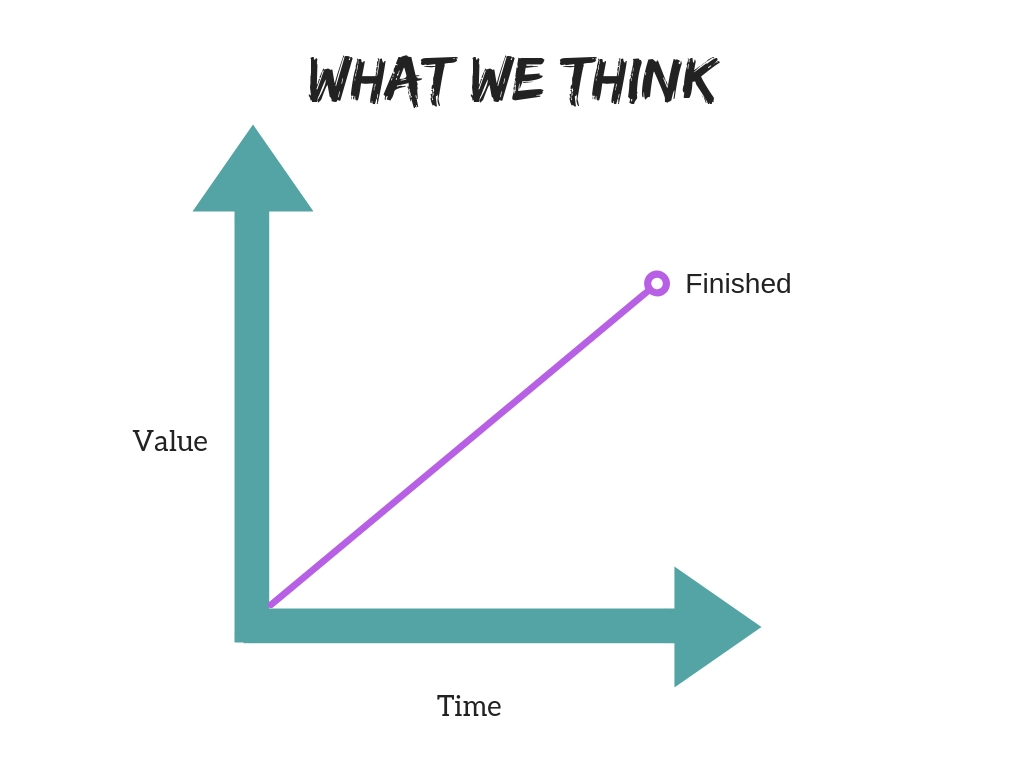
Let’s first look at how we think value creation works:

Value created - perception

See above, how over time, the value we create goes up as the task becomes completed.

This seems right, because it is the way we are trained.

We are trained to think that when we have half-way written our essay, we are half-way done. That half the value of the task has been contributed.

But is that really the case?

Not really, no.

The real world doesn’t reward things that are half-way done. Or even 95% done.

Below is a more accurate graph of the value creation process:

Value created - actual

It’s the act of finishing that turns all our efforts into a return.

Look how the value we contribute is negative (an opportunity cost) right up until the job is finished.

The time of maximum danger is not the beginning of a task, it is just before the very end. Because until something is finished there is no value. There is only a loss of potential.

I often have to remind myself to break jobs down into smaller completable tasks.

To release small amounts of value more often. To work the extra hour and get the job finished.

Posted in Uncategorized | Leave a comment

Changing The World With Data

This article was first published in M2 Magazine, before we changed our name to SaferMe. Since the post mostly about me, I’ve just republished it here on my blog – full credit to Andre at M2.

As an ex-mechanical engineer and farmer, Clint Van Marrewijk has probably had a varied pathway to co-founding a data driven New Zealand company that is gaining exponential global growth and changing the way that people are interacting with their environment.

While ThunderMaps is being used by councils and large organisations around the globe, the concept was sparked by van Marrewijk’s time at a KiwiSaver company where he helped to develop back-end systems which utilised data. It was here that he realised the power of data. When the business was sold to Kiwibank in 2012, van Marrewijk saw an opportunity to build a company that took this relationship with data even further.

The result is ThunderMaps, a system that integrates with a number of services to find relevant data specific to a geographic area – data is scanned from a variety of sources such as weather and emergency callouts and so on. The resulting system feeds apps for different contexts. The current offerings are risk reporting, smart cities and mobile data collection apps. Each one using the power of digital information to create a real tangible impact on the way that companies, organisations, governments, councils and individuals relate to their environments.

Did you always know you wanted to be an entrepreneur?

I grew up a typical Kiwi kid growing up on a dairy farm. I used to buy calves off dad and raise them on old milk, and sell them back to the neighbor. Every year I used to buy three piglets and raise them up on scraps and sell them. But that was just for cash. Typical farming kid, I guess. And then milking cows, shifting hay bales. But yeah, I mean no more than anyone else.

And the technology side, when did the two things meet?

I guess it’s an accident. I went through university like most people do and then I did engineering. Then to get my first job – instead of looking for an engineering company, I just made a list of companies I thought would grow really quickly. So this is in 2006. I went and visited them all and checked them out, and then ended up picking an investment company.

Certainly, I’d recommend it as a path for others. Not to choose the industry, but to choose the business. And to look for that business that’s at the right stage, so that you can grow with it.

And this was when KiwiSaver was coming out, which was a government sponsored scheme. And it was obviously going to be a really big company. At the time it was quite small. And I just went in there, and drove my Holden down to Wellington, literally. Parked on the side of the road, went up the elevator and sort of stood there and said, “Oh, I want to work for your company, it’s going to be massive, it’s going to great. I’ll take any job you’ve got.”

They hired me, and I was there for 7 years, and it was sold to Kiwibank. So that was kind of a good start. Because it was a small team that grew big there was lots of tech and building things along the way. And then [I] started this project. Well it started as an experiment, I guess – while I was still there. Then the company was in the buyout process, and then I just carried on.

And what was it about that sort of environment? Do you think that was a springboard for the success you’re having now?

Yes, absolutely. I mean luck is everything. I think variety is important. I mean, you want to truly have some skill to fall back on. And luckily, the first job there was – it was something I could throw myself into and get good at. Then once you’ve got at least some skill, you can build up from that. I think the fact that the company was growing was incredibly important. Certainly, I’d recommend it as a path for others. Not to choose the industry, but to choose the business. And to look for that business that’s at the right stage, so that you can grow with it.

Were you always conscious of the fact that you were going to go and do something on your own at some point?

No I wasn’t one of those people that knew what they wanted to be. I just followed the path that was in front of me until I  got off the train tracks of life after uni. And then obviously travelled and came back and was a farmer for a year and a half and just sort of thought about where would be a great place to work, and went there.

And what was the catalyst for that first experiment that has essentially become this global business for you?

One of the things that I was doing at the KiwiSaver company was taking lots of data types and figuring out information on each person and how best to maximise the service to them. During that, I figured out there was all this data just sitting there that wasn’t really being used properly. So with the first experiment I just hired a couple of developers to do some experiments with data and try and make it useful. And that was where ThunderMaps began. But for the first year or two years, I didn’t think it would work at all. And then it was really only about two years ago that it sort of kicked off and got client after client. We opened a Swedish office in 2015. We opened the London office eight months [or] nine months ago.

Clint Van Marrewijk_M2 Magazine Article

Clint Van Marrewijk of ThunderMaps

What was the trigger for the success?

My dumb persistence, I guess. Just surviving long enough to grow past your own mistakes as well. Your limitation is yourself, and you’re never more aware of that when you are leading the company. I mean, so when you were coming up through another company – you always feel like there’s someone in your way, and you always feel like they are the one that’s stopping you doing what needs to be done, and it’s quite annoying. But then what’s quite humbling, is that you get to not be anyone in the way anymore at all. And you realise that you’re the limiting factor.

There’s the old thing about founders and CEOs not necessarily being the same thing. Is there part of an evolution of growth that you are thinking about in terms of your role?

Certainly your job description changes, and you have to change with it. And just treat it as a learning experience. Because everything you do, you’re not very good at it. So you have to quickly get better. And also realise where you’re not good, and then also realise what you should farm out first. So I feel like the only things that will remain as part of my role if I was to stay a CEO is essentially sales and HR. That’s the main thing – financing as well, investment type stuff. But after that, everything else kind of gets farmed out. All the product management and other things.

To go back to the early days, where you say it was pure perseverance and working through mistakes were there any clues that there was something there?

That it wasn’t stupid? Not particularly. I mean I felt it should exist. And therefore, why not do it? Life’s very limited, you’ve got no time, so if you’re going to do something, you might as well have a real crack.

As you grow how do you instill your passion and philosophy into the team?

I actually don’t know the answer. I’ve talked to people about how you help the culture stay the way it is, and be the way you want it. I actually don’t know. We’re trying to work on that. I don’t have any magic sort of way. We do believe in certain things. Like we believe in ownership, I want people to have that same opportunity I had – where – if they want to own some of the company, they can. And then in six years, when you get bought out, you have some cash to start your own thing if you want to. But we’ve got no sort of ethos yet. Or we haven’t written that statement that says what we are yet.

Do you think that the startup process has been harder or easier by being initially based in New Zealand, as opposed to say if you were around the corner in Silicon Valley?

It’s funny, when we’re selling to New Zealand we’ll often start it from Sweden. So our first call will be from Sweden to New Zealand. And the CIO or whoever we are trying to target they’ll come in and they’ll have a Skype session with this “innovative Swedish company”. And then they’ll sit at the water cooler, and they’ll say, “Oh I’ve just been doing this innovative thing from Europe.” And then they’ll set up the second meeting, and we’ll come in, and the New Zealand arm of this company will come and sell the product. Interestingly, when we’re selling in Sweden, we never do it that way. So we always say, “We’re Swedish, Sweden. Swedish made.” And yeah, so it’s a different psyche. You kind of see it in our buy New Zealand Made campaign. So you buy New Zealand made, because you know the guy. It’s your local. That it is not good. But it’s Kiwi. Whereas when you see a Swedish, “buy Swedish,” you buy Swedish because it’s Swedish – it’s better. So they really believe in themselves. I don’t think we’ve quite got there yet. But we should one day.

Does that highlight a New Zealand attitude that we’re going to need to face before we can really ramp up our industry here. Do we need to kind of get over ourselves a little bit?

I think it’s coming. I mean it very much feels like a New Zealand company – in the eyes of other New Zealand companies – isn’t achieving until it’s achieving internationally. And that’s just because we’re small, we all travel.

And in terms of having a development team based here, are there any limitations?

I wouldn’t say so. If anything there are advantages over many parts of the world. You have a highly educated workforce. They’re not as expensive as the US by any stretch, or even Aussie. But they’re just as good. And you’ll get a lot of people coming to New Zealand, because they really want to live here. I think we’ve got a fantastic team, there’s no doubt about that. It’s a really good start.

What’s your vision for the next five years of your business – where do you think you’ll be?

At the moment we’re focusing very much on large global teams and enterprise customers. So you’re talking 1000 plus or 400 to 500 people at the minimum size. We give them a branded product, it’s very bespoke from their point of view. Although from our point of view, it’s just off the shelf. This phase of our business is all about this much more expensive product. But obviously there’s more margin for us. So we’re spitting that out over and over and over again, and making the money. But that’s actually to finance the next stage of our business, which is at the smaller end, using the data that we’re accumulating now to create a consumer level product. So there’s kind of stages to what we’re doing and it seems relatively straightforward what we have to do. We just have to clock on and keep working.

In terms of the experience that you’ve had mentoring budding entrepreneurs what are some of the best things that we can do in terms of, in terms of teaching our children entrepreneurial thinking?

I think getting into business early is good. So what I mean by that is children actually doing something to make money at a very young age. When I think about a lot of the entrepreneurs I know, or people who have made a lot of money, they often start extremely young. So eight, nine or ten-years-old doing some sort of activity and over a period of months to earn money in some innovative way selling or making things, or raising pigs or calves or whatever it is.

Posted in Uncategorized | Leave a comment

Meeting Usain Bolt

A few weeks ago my friend asked me to fly with him to Germany to meet Usain Bolt.

He had a package tour, and he offered to shout me the trip.

It’s the type of offer that can’t easily be turned down. Particularly as the timing meant we would be arriving during Oktoberfest… German beer and sausage are extremely appealing things.

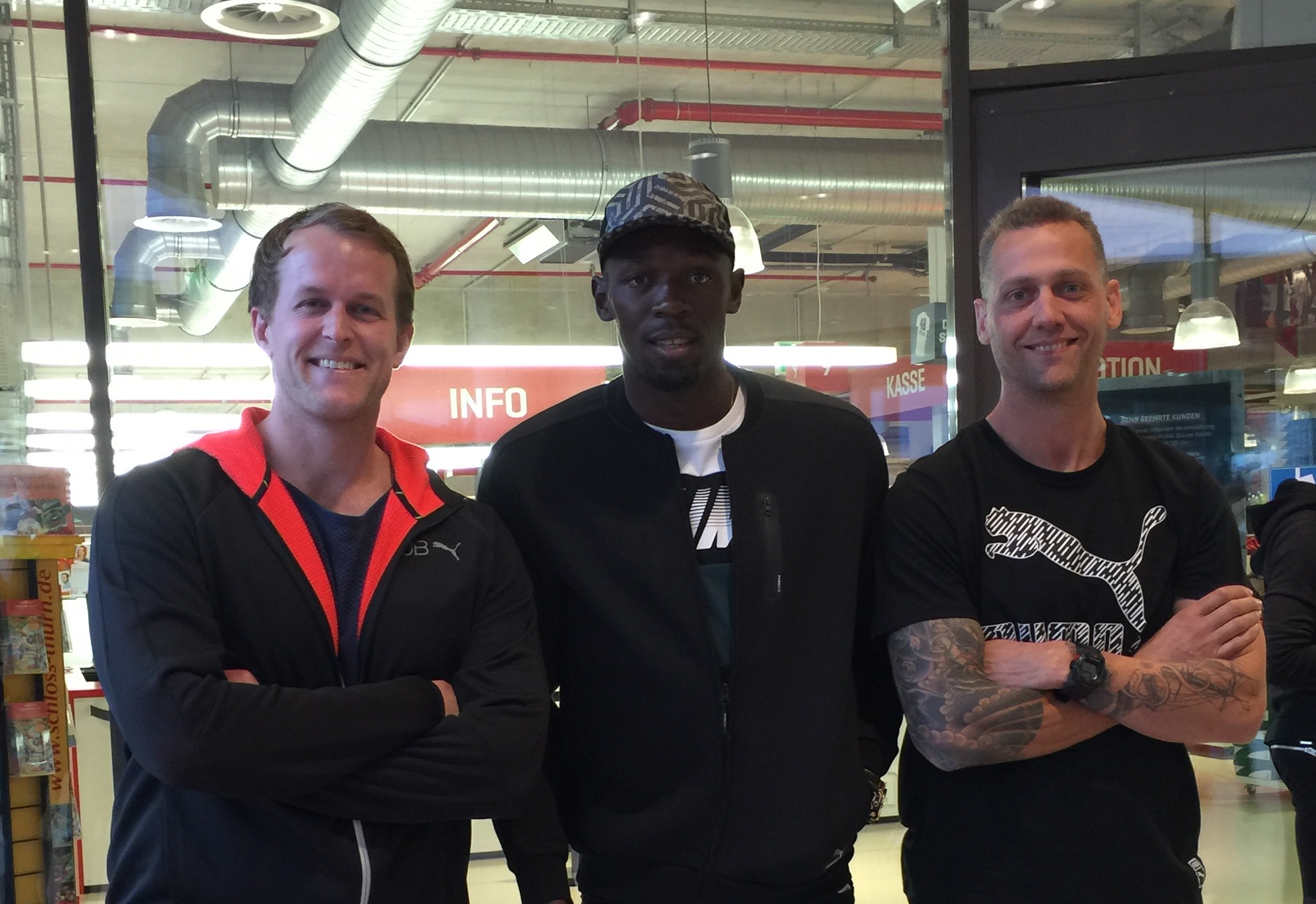
Usain Bolt and Clint Van Marrewijk

So what’s Usain Bolt like?

We met him in the Puma factory in Herzogenaurach (Puma sponsor him), which had high concrete ceilings and exposed ducting – the typical modern yet cold factory store layout, that you may be familiar with.

The first thing you notice is that he’s tall and fine boned. Surprisingly so.

He’s like a greyhound or thoroughbred – slim, finely built and long limbed – which I suppose is of little surprise to most people.

Arguably the greatest athlete of all time

As for his demeanor. It’s hard to know what someone is truly like after only a first impression, but to me, he seemed watchful, accommodating and friendly. Underneath the hoopla and persona that follows him, he appeared reasonably shy with a down-to-earth character, and with no pretentiousness.

After meeting the man, and hitting the Puma store, it was time to get to Munich and get into some Oktoberfest action. [No not with Usain Bolt. Just us Kiwis checking out the sights]

beers at oktoberfest 2016

I’d heard about Oktoberfest many times, but I was not prepared for how truly big the event was.

Here are some statistics for you:

  • Total people attending: 7.2 Million
  • Total chickens eaten: 550,000
  • Enough seating to accommodate 100,000 beer drinkers

More Oktoberfest statistics can be found here.

It was a good week away.

Now that I’m back Wellington, it’s time to hit the gym, to make up for turning myself into a walking German sausage.

giant german circular bbq.jpg

Who doesn’t like a giant spinning BBQ of meat?

Posted in Uncategorized | Leave a comment

100 books worth giving

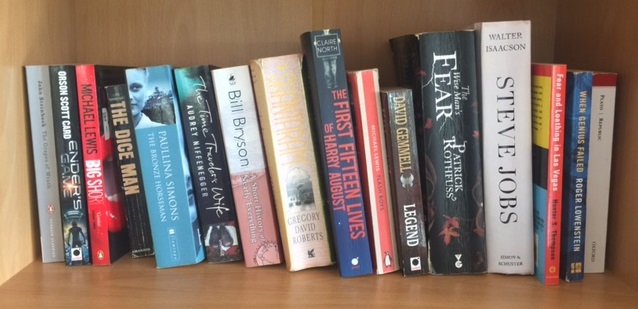
I’ve been building a bookshelf of 100 books for the last 10 years – books that can be easily recommended – for the “My daughter, when you’ve read these you will be a woman”  type recommendation.

snapshot of some books.jpg

What’s nice about this, is that when I read a book I think “makes the cut”, I then go back and read the book it’s going to replace, again. To make a decision.

Here’s the list at the moment, in no particular order:

  1. Charlie Mike, Leonard B Scott
  2. A Short History of Progress, Ronald Wright
  3. King Rat, James Clavell
  4. The Black Swan, Nassim Nicolas Taleb
  5. The Bronze Horseman, Paullina Simons
  6. The First Tycoon: The Epic Life of Cornelius Vanderbilt, T.J. Stiles
  7. Catch Me If You Can, Frank Abagnale Junior
  8. Value Investing, Seth Klarman
  9. A Random Walk Down Wall Street, Burton Malkiel
  10. Reminiscences of a Stock Operator, ‎Edwin Lefèvre
  11. A Good Keen Man, Barry Crump
  12. Fear and Loathing in Las Vegas, Hunter S. Thompson
  13. Cod, Mark Kurlansky
  14. Salt, Mark Kurlansky
  15. The Rise and Fall of the Third Chimpanzee, Jared Diamond
  16. A Short History of the Twentieth Century, Geoffrey Blainey
  17. Against the gods, Peter Bernstein
  18. The Ascent of Money, Nail Ferguson
  19. Sherlock Holmes, Arthur Conan Doyle
  20. 1984, George Orwell
  21. The Time Traveler’s Wife, Audrey Niffenegger
  22. The Saga of Recluce, L. E. Modesitt Jr.
  23. Catch 22, Joseph Heller
  24. When the Lion Feeds, Wilber Smith
  25. The Power of One, Bryce Courtenay
  26. Birds of Prey, Wilber Smith
  27. Zero to One, Peter Thiel
  28. One day in the life of Ivan Denisovich, Aleksandar Solzhenitsyn
  29. Titan: The Life of John D. Rockefeller, by Ron Chernow
  30. The Bourne Identity, Robert Lundum
  31. The Horse Whisperer, Nicholas Evans
  32. The Hobbit, J R R Tolkien
  33. The Old Man and the Sea, Ernest Hemingway
  34. Forrest Gump, Winston groom
  35. The Tipping Point, Malcolm Gladwell
  36. Heroes – a history of hero worship, Lucy Hughes Hallett
  37. The Clan of the Cave Bear, Jean M auel
  38. Engineers’ Dreams, Willy Ley
  39. Republic, Plato
  40. The Great Gatsby, F Scott Fitzgerald
  41. The Lord of the Rings, J R R Tolkien
  42. The Picture of Dorian Grey, Oscar Wilde
  43. The Name Of The Wind, Patrick Rothfus
  44. Status Anxiety, Alain de Botton
  45. The Grapes of Wrath, John Steinbeck
  46. The Art of War, Sun Tzu
  47. Power of the Sword, Wilber Smith
  48. Open Society, George Soros
  49. Made in America, Sam Walton
  50. Killing Floor, Lee Child
  51. The Consolations of Philosophy, Alain de Botton
  52. A Brief History of Economic Genius, Paul Strathern
  53. Outliers, Malcolm Gladwell
  54. The agony and the ecstasy, Irving Stone
  55. Shantaram, Gregory David Roberts
  56. When Genius Failed, Roger Lowstein
  57. A Short History of Nearly Everything, Bill Bryson
  58. The Catcher in the Rye, J D Salinger
  59. Chickenhawk, Robert Mason
  60. The Intelligent Investor, Benjamin Graham
  61. Sushi For Beginners, Marian Keyes
  62. The pillars of earth, Ken Follett
  63. Captain Corelli’s Mandolin, Louis Bernieres
  64. The burning shore, Wilber Smith
  65. The Eagle and Raven, James A Michener
  66. Sapiens: A Brief History of Humankind by Yuval Noah Harari
  67. Cross Stitch, Diana Gabaldon
  68. The Godfather, Mario Puzo
  69. South, Ernest Shackleton
  70. Sophie’s World, Jostein Gaarder
  71. Dracula, Bram Stoker
  72. If This Is a Man, Premo Levi
  73. The Sleep Walkers, Arthur koestulul
  74. The Weather Makers, Tim Flannery
  75. Bastards I have met, Barry Crump
  76. The Alchemist, Paulo Coello
  77. For Us The Living, Robert A Heinlein
  78. Fooled by Randomness, Nassim Nicolas Taleb
  79. A Farewell to Arms, Ernest Hemingway
  80. A History of the World in 6 Glasses, Tom Standage
  81. The Andromeda Strain, Michael Crichton
  82. Adventures of Huckleberry Finn, Mark Twain
  83. Gone Girl, Gillian Flynn
  84. The Count of Monte Cristo, Alexandar Dumas
  85. 2001: A space odyssey, Arthur C. Clarke
  86. The Martian, Andy Weir
  87. How Britain Made the Modern World, Niall Ferguson
  88. The Convenient, James A Michener
  89. The Swiss Family Robinson, J D Wyss
  90. Dune, Frank Herbert
  91. On The Road, Jack Kerouac
  92. Trainspotting, Irvine Welsh
  93. The Fountainhead, Ayn Rand
  94. The Inevitable – Kevin Kelly
  95. A Painted Horse, John Grisham
  96. The Blade Itself, Joe Abercrombie
  97. Steve Jobs, Walter Isaacson
  98. Enders Game, Orson Scott Card
  99. The First Fifteen Lives of Harry August, Clare North
  100. Flashboys, Michael Lewis

I’ll keep reading and improving this list of 100 books, and will update it here from now on.

Posted in Uncategorized | 5 Comments

Xero’s search marketing analysed

Firstly – my thanks to Experian for most of the data used in this post.

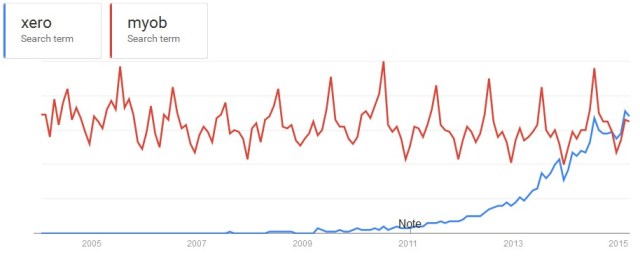
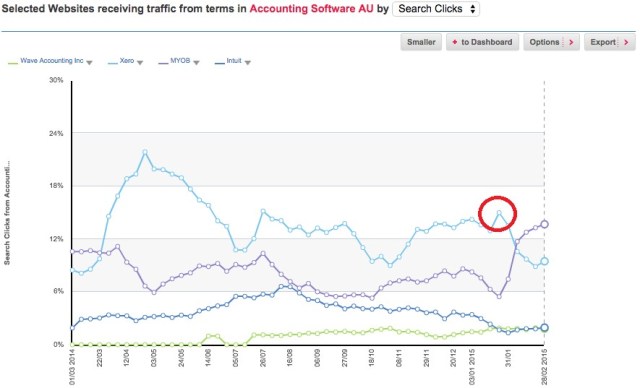
Xero’s brand has recently overtaken MYOB in Australia (see graph below), but I thought it would be interesting to dig deeper into the underlying data.

Comparing Xero and MYOB brands in Australia

Let’s first investigate how Xero is tracking for generic search share.

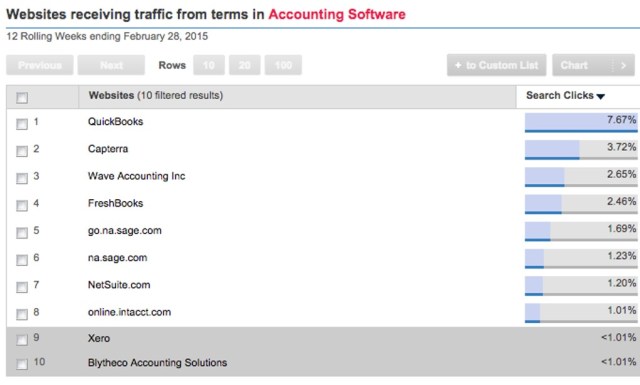
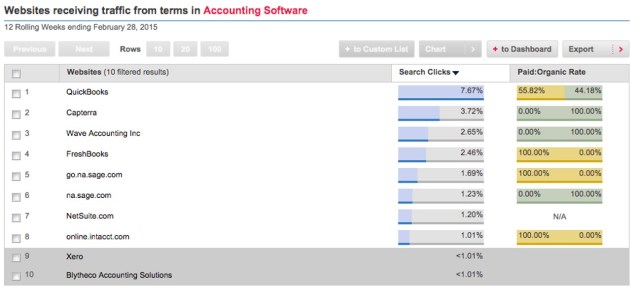
This table below shows the websites that people end up on, when they search for the 500 most important generic search terms, in the online accounting industry:

Generic Search Traffic for Online Accounting Australia

Above we are strictly looking at generic search share above. Not branded traffic.

Generic search share is a proxy for search marketing effectiveness specifically.

Generic search share is valuable for a couple of reasons 1) because it is mostly independent of “brand building”, which is expensive and time consuming for a business, and 2) it’s the “search intent” that is the most valuable – user intent that may not yet be associated with a brand. Generic search is where new users may be looking for the product or information generically.

Now let’s look at the US market. Below is Xero’s generic search share in the US, again for the same 500 most important generic search terms:

Generic Search Traffic for Online Accounting US
These two tables above are mostly what you would expect to see from Xero:

  1. They are near the top in Australia, only beaten by MYOB.
  2. Xero are just starting out in the US – they don’t register. QuickBooks is dominating that market still.

Given Xero’s rapid rise, it is somewhat unexpected that Xero is not the outright generic search leader in Australia yet.

For the sake of curiosity, let’s quickly investigate this Australian anomaly.

Here’s a graph of generic search share in Australia, for Xero, Intuit, MYOB and Wave:

Generic Search Traffic Graph Online Accounting Australia 2014

Again, we are looking at generic search share above, and yes, Xero has been overtaken recently.

There are a couple interesting points from the graph:

  • Xero’s trend is mostly flat for the year. I expected to see Xero leading in Australia and extending its lead. But MYOB have recently overtaken Xero.
  • Some sort of event occurred near the start of this year (see red circle above), which appears to have had a negative effect on Xero capturing generic traffic and/or a positive impact on MYOB share. These sorts of moves can sometimes be the result of a site or content restructure, and it remains to be seen if this trend will be permanent.

Let’s now look at Xero’s paid search strategy:

Although paid search is a different kettle of fish to organic search, many of the same principles apply when comparing performance. There is one general question that’s the most significant for both disciplines: where is the generic search traffic going?

The below table shows Xero’s US competitors, again for the 500 most important generic search queries in the “online accounting industry”. The right hand column indicates how much of each company’s generic traffic is paid for:

Paid Search Traffic for Online Accounting US

For US paid search above, what are the points of interest?

  • FreshBooks pays for almost every generic term is gets
  • QuickBooks receives the majority of generic traffic available, and is the largest recipient of paid generic traffic too
  • Xero is not getting generic clicks, and is certainly not trying to pay for them.

Xero’s lack of paid search effort is interesting.  There is some surprise for me with that stat. I suspect it won’t last, as there will already be user search intent that Xero is better suited to convert than its competitors – that they therefore could profit from, with relative ease and speed. A good place for Xero to start is to look at the generic search intent that they already convert on, but don’t necessarily rank highly for organically… let’s see where Xero are at with this again next year.

What about branded traffic share in the US?

Branded search traffic is generated by existing customers or via promotions not directly related to search marketing – events, partnerships, bog-standard advertising, banner impressions, word of mouth, etc.

Below we graph the amount of search terms that contain the word “Xero” and “QuickBooks” in the US:

Branded Search Traffic Graph for Xero Quickbooks
This graph above is encouraging for Xero.

For an online business, there is scarcely a more real-time, independent and accurate tracker of relative company performance than total branded search share. This will be a telling stat to watch over the coming years.

Xero’s brand is starting to gain traction when compared to the largest competitor’s brand. Brand marketing is where Xero has been a proven performer in other markets, and the data shows their efforts are at least starting to work in the US market. Let’s see…

With a little more modeling it would be possible to estimate the total marketing spend required in each respective market, but let’s leave this for a later post.

Conclusions:

What are the main things to take away from the data?

There are some patterns. In both Australia and the US, Xero’s share of generic search traffic, both organic and paid, is less than one would expect from a company with its overall brand strength.

If anything Xero’s search marketing “silence” must be quite freighting for its competitors. Scary by omission. What if Xero tries to attack generic search with PPC?

Even so, graphs of branded traffic share show that Xero’s overall marketing spend is having at least some impact, even in the large US market.

  • Following on from Xero’s online strategy in Australia, there is little generic search emphasis being applied by Xero in the US.
  • Xero puts no effort into paid search in the US, which stands out when looking at how competitors allocate resources, but matches Xero’s history in Australia.
  • Xero are starting to make traction in the US – from a low base. This has been seen before in Australia and New Zealand and is encouraging for the company.

A couple of additional questions:

  1. Does search marketing even matter that much? I personally think it does. But Xero’s success so far in smaller markets, seems to prove it is not critical, there.
  2. How good could Xero be if it figured search marketing out? Scary good probably, which leaves me in a hopeful position for them.


Thanks and disclaimers:

Posted in Uncategorized | Leave a comment

Net Run Rate tie breaker needs to be improved

Many sports have playoff selection systems that are sub-optimal in one way or another.

But the Cricket World Cup’s Net Run Rate tie-breaker seems to stand out as pretty bad.

Let’s take a deeper look at why there could be a problem, and what could be done to improve it.

  • Background on tournament rules: each team plays 6 pool games, and receives 2 points for a win, and 1 point for a draw or no result. There are two pools of 7 teams, and after the pool play the top 4 teams in each pool are pushed through into a sudden death format. Firstly, if teams are on equal points at the end of pool play, the team with the most wins will progress (more details in the official rules).

Nothing surprising here so far.

The kicker though, is in the Net Run Rate (NRR) mechanism used to rank teams that finish the pool stage on equal points and equal wins.

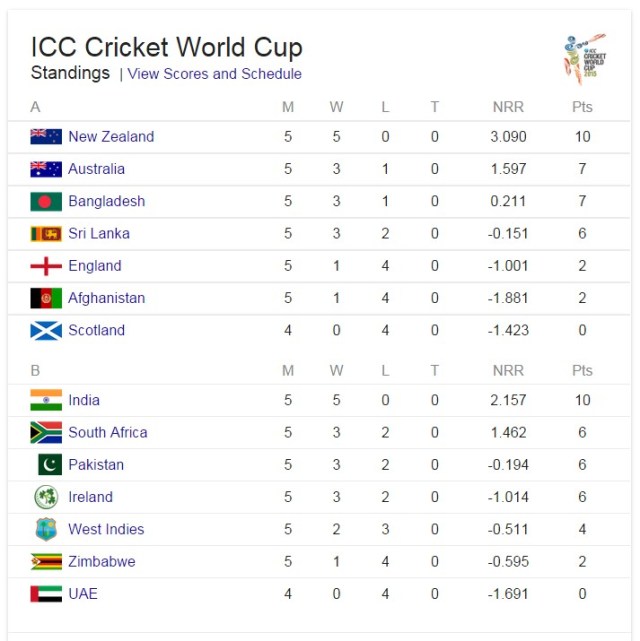
Please note below that there are 7 teams that are currently ranked subject to NRR, and that only four teams in each pool can make the finals. It’s therefore important that NRR is as accurate as possible.

Cricket world cup table 11_03

So what’s the problem?

The NRR equation does not take into account wickets lost for teams that successfully chase a target score. Why is this strange?

Teams that only just win, can have higher NRR’s than teams that win their games easily – this is counter to the point of using NRR as a tie-breaker.

What’s the alternative to NRR?

Let’s understand one improvement to the NRR equation that could be made.

What’s really strange, is that there is a better system and cricket already does use it to determine the score in rain-affected matches.

Why not use the same system to project second innings scores, in the NRR equation?

  • Duckworth Lewis calculates what a batting team would have gotten based on runs, overs and wickets in hand.
  • Duckworth Lewis isn’t perfect, but the ICC does trust it to decide games, so why not trust it to decide a lesser thing – i.e. ties between teams on the table
  • It’s absurd to even require teams to score quickly in an easy chase. For example, if India wins by 10 wickets but only had an over to spare, they absolutely smashed the other team – that’s how cricket works. NRR should record India’s chase fairly, but it does not.

What should happen:

Where a successful chase is less than 50 overs, the chasing team’s score should be extrapolated to 50 overs, and those missing overs should be included in the NRR equation for both teams – this would more accurately reflect the cumulative margin of victory.

Below is a comparison of the current tournament standings. In this table there is an extra column on the right hand side “NetRRad”, which adjusts NRR when the chasing team wins, to more accurately reflect margin of victory.

NRR adjusted by duckworth lewis

Fortunately no team moves up or down due to the “suboptimalness” of NRR at the moment. It will be interesting to check back again at the end of pool play.

However, there are significant adjustments to the NRR of many teams, when a Duckworth Lewis approach is used.

New Zealand in particular appears to be taking great advantage. New Zealand has chased down scores aggressively, seemingly at the expense of wickets lost, and they now have an almost insurmountable, if unfairly high NRR.

Posted in Uncategorized | 2 Comments

Welcome

Welcome to a simple site that occupies the SERP for a low volume search term that’s important to me personally.

If for some reason you want to learn more about me, go here.

Posted in Uncategorized | Leave a comment