
Firstly – my thanks to Experian for most of the data used in this post.
Xero’s brand has recently overtaken MYOB in Australia (see graph below), but I thought it would be interesting to dig deeper into the underlying data.

Let’s first investigate how Xero is tracking for generic search share.
This table below shows the websites that people end up on, when they search for the 500 most important generic search terms, in the online accounting industry:
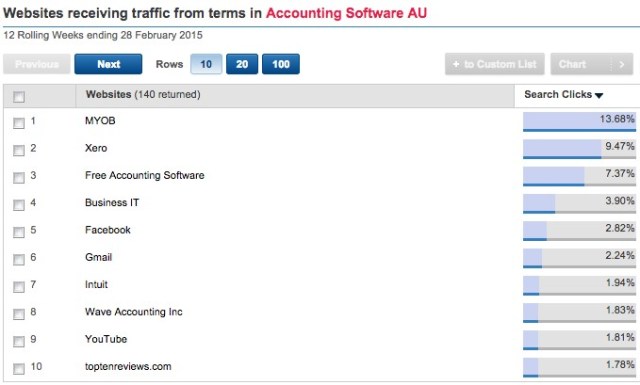
Above we are strictly looking at generic search share above. Not branded traffic.
Generic search share is a proxy for search marketing effectiveness specifically.
Generic search share is valuable for a couple of reasons 1) because it is mostly independent of “brand building”, which is expensive and time consuming for a business, and 2) it’s the “search intent” that is the most valuable – user intent that may not yet be associated with a brand. Generic search is where new users may be looking for the product or information generically.
Now let’s look at the US market. Below is Xero’s generic search share in the US, again for the same 500 most important generic search terms:

These two tables above are mostly what you would expect to see from Xero:
- They are near the top in Australia, only beaten by MYOB.
- Xero are just starting out in the US – they don’t register. QuickBooks is dominating that market still.
Given Xero’s rapid rise, it is somewhat unexpected that Xero is not the outright generic search leader in Australia yet.
For the sake of curiosity, let’s quickly investigate this Australian anomaly.
Here’s a graph of generic search share in Australia, for Xero, Intuit, MYOB and Wave:

Again, we are looking at generic search share above, and yes, Xero has been overtaken recently.
There are a couple interesting points from the graph:
- Xero’s trend is mostly flat for the year. I expected to see Xero leading in Australia and extending its lead. But MYOB have recently overtaken Xero.
- Some sort of event occurred near the start of this year (see red circle above), which appears to have had a negative effect on Xero capturing generic traffic and/or a positive impact on MYOB share. These sorts of moves can sometimes be the result of a site or content restructure, and it remains to be seen if this trend will be permanent.
Let’s now look at Xero’s paid search strategy:
Although paid search is a different kettle of fish to organic search, many of the same principles apply when comparing performance. There is one general question that’s the most significant for both disciplines: where is the generic search traffic going?
The below table shows Xero’s US competitors, again for the 500 most important generic search queries in the “online accounting industry”. The right hand column indicates how much of each company’s generic traffic is paid for:
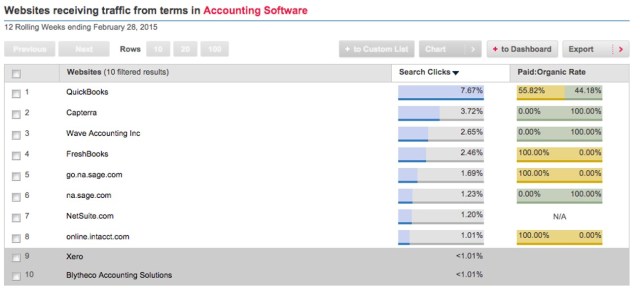
For US paid search above, what are the points of interest?
- FreshBooks pays for almost every generic term is gets
- QuickBooks receives the majority of generic traffic available, and is the largest recipient of paid generic traffic too
- Xero is not getting generic clicks, and is certainly not trying to pay for them.
Xero’s lack of paid search effort is interesting. There is some surprise for me with that stat. I suspect it won’t last, as there will already be user search intent that Xero is better suited to convert than its competitors – that they therefore could profit from, with relative ease and speed. A good place for Xero to start is to look at the generic search intent that they already convert on, but don’t necessarily rank highly for organically… let’s see where Xero are at with this again next year.
What about branded traffic share in the US?
Branded search traffic is generated by existing customers or via promotions not directly related to search marketing – events, partnerships, bog-standard advertising, banner impressions, word of mouth, etc.
Below we graph the amount of search terms that contain the word “Xero” and “QuickBooks” in the US:

This graph above is encouraging for Xero.
For an online business, there is scarcely a more real-time, independent and accurate tracker of relative company performance than total branded search share. This will be a telling stat to watch over the coming years.
Xero’s brand is starting to gain traction when compared to the largest competitor’s brand. Brand marketing is where Xero has been a proven performer in other markets, and the data shows their efforts are at least starting to work in the US market. Let’s see…
With a little more modeling it would be possible to estimate the total marketing spend required in each respective market, but let’s leave this for a later post.
Conclusions:
What are the main things to take away from the data?
There are some patterns. In both Australia and the US, Xero’s share of generic search traffic, both organic and paid, is less than one would expect from a company with its overall brand strength.
If anything Xero’s search marketing “silence” must be quite freighting for its competitors. Scary by omission. What if Xero tries to attack generic search with PPC?
Even so, graphs of branded traffic share show that Xero’s overall marketing spend is having at least some impact, even in the large US market.
- Following on from Xero’s online strategy in Australia, there is little generic search emphasis being applied by Xero in the US.
- Xero puts no effort into paid search in the US, which stands out when looking at how competitors allocate resources, but matches Xero’s history in Australia.
- Xero are starting to make traction in the US – from a low base. This has been seen before in Australia and New Zealand and is encouraging for the company.
A couple of additional questions:
- Does search marketing even matter that much? I personally think it does. But Xero’s success so far in smaller markets, seems to prove it is not critical, there.
- How good could Xero be if it figured search marketing out? Scary good probably, which leaves me in a hopeful position for them.
Thanks and disclaimers:
- Thanks to John-Daniel Trask, who convinced me to start posting to my blog on a more regular basis
- Thanks to Experian for the Hitwise data used in this post

 Clint Van Marrewijk